
Ever wondered why some money seems to grow quicker than others? You might think every interest rate works the same, but it doesn't. Simple interest is like a plain slice of bread, steady and predictable. Meanwhile, compound interest builds up like stacking blocks, growing bit by bit.
Today, we're having a heart-to-heart about how both types work. Even small changes can give your money a boost over time. Ready to learn some easy tips on simple versus compound interest? This might just change the way you look at your savings and loans.
2. simple interest vs compound interest: Quick Insights
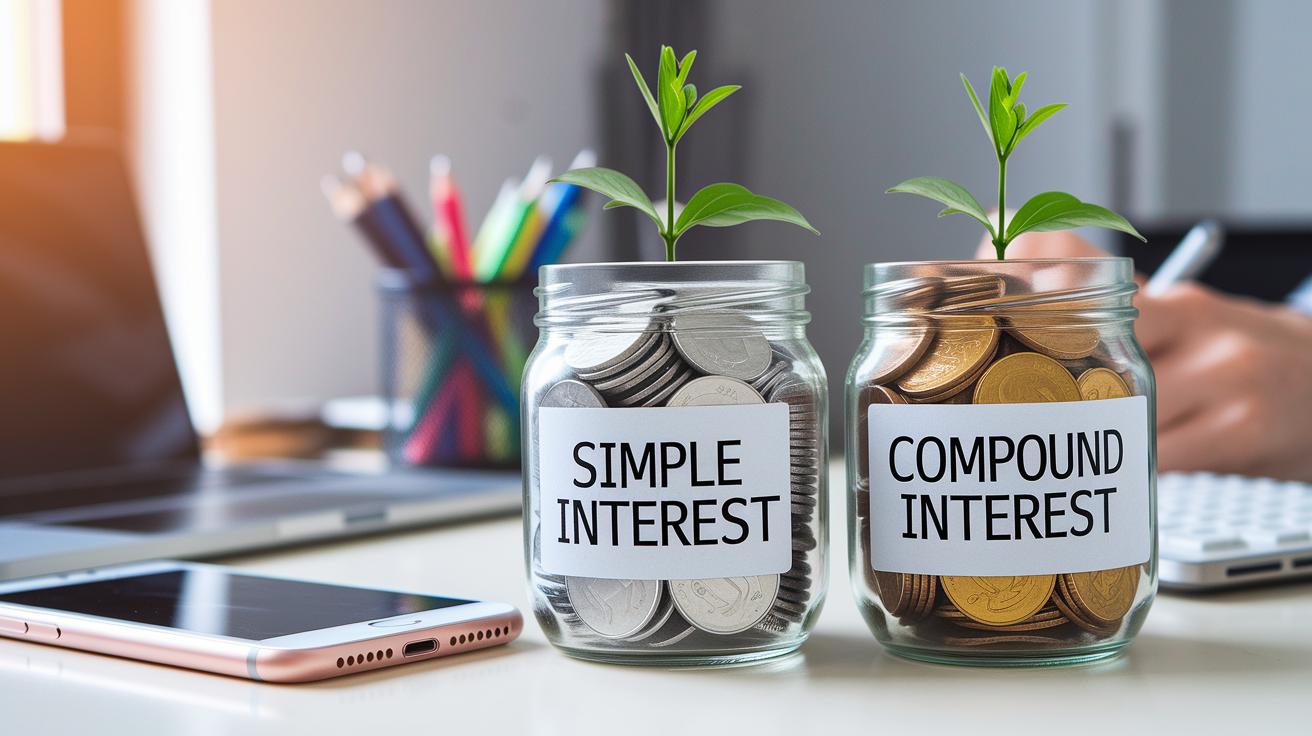
Simple interest is all about calculating only on the original amount you invest. It follows a straightforward rule: Interest = P × R × T. Here, P means your starting money, R is the yearly rate as a decimal, and T is the time in years. For example, if you put $1,000 into an account at a 4% rate for 3 years, your extra money comes out to $1,000 × 0.04 × 3, which is $120. It’s like having the same slice of bread on your plate at every meal – consistent and steady without any surprises.
Compound interest, on the other hand, grows your money faster. With it, your earnings not only count on your original amount but also add on the interest that builds up over time. The formula looks like this: A = P × (1 + R/N)^(N×T), where N is how many times the interest is added back each year. Think of it this way: if you invest $1,000 at a 4% rate that compounds quarterly (four times a year) for 3 years, your total money grows to about $1,126.49. It’s like stacking layers on top of one another, with each new layer making the pile even larger.
Different banks and investment services might choose one method over the other based on what they’re offering. Simple interest is common in some loans and certificates of deposit, giving you a clear and predictable outcome. Meanwhile, compound interest is often found in investment accounts and credit cards, where letting your interest work for you can really boost your money over time. Whether you’re borrowing or investing, a small change in the rate or how often the interest is added can make a big difference in your financial future.
Step-by-Step Calculations: Simple Interest vs Compound Interest

Working through these calculations helps you see the difference between simple and compound interest in a clear, hands-on way. We’ve added extra examples to show how changing the starting amount, time, or compounding frequency can shift the outcome.
Calculating Simple Interest
To calculate simple interest, use the formula I = P × R × T. Here, P stands for your starting amount, R is the annual rate written as a decimal, and T represents the number of years.
For instance, if you start with $1,000 at a 4% rate for 3 years, you calculate:
I = $1,000 × 0.04 × 3 = $120.
It’s like adding $40 each year, steady and predictable. Many people don’t realize how even a small amount can add up over several years.
Now, if you extend the time to 5 years with the same $1,000 and rate, your calculation is:
I = $1,000 × 0.04 × 5 = $200.
This shows that a longer duration naturally leads to more interest accumulated.
Calculating Compound Interest
For compound interest, the formula to use is A = P × (1 + R/N)^(N×T), where N is the number of compounding periods each year. This method lets interest build on top of interest.
Consider this example: With $1,000 at a 4% annual rate compounded quarterly (N = 4) over 3 years, you find:
A = $1,000 × (1 + 0.04/4)^(4×3) ≈ $1,126.49.
Every quarter, your interest builds on the previous total, which can be quite surprising since small, frequent additions boost your gains more than you might expect.
If you change the compounding to monthly (N = 12) while keeping the other factors the same, you get:
A = $1,000 × (1 + 0.04/12)^(12×3) ≈ $1,127.16.
That small increase shows how more frequent compounding leads to even greater growth over time.
Simple vs Compound Interest: Side-by-Side Comparison

This table shows you the key differences in how simple and compound interest work. You’ll see that simple interest grows in a straight line, but compound interest builds on itself and speeds up over time. This quick visual breaks it down by growth pattern, formula, rate impact, time impact, and a real-life example we talked about earlier.
| Parameter | Simple Interest | Compound Interest |
|---|---|---|
| Growth Pattern | Linear | Exponential |
| Formula | I = P×R×T | A = P(1+R/N)^(N×T) |
| Rate Impact | Proportional | Amplified by rate & frequency |
| Time Impact | Directly proportional | Accelerates over time |
| Example (P=$1,000, R=5%, T=3) | $150 | $157.62 (annual) |
Imagine this surprising fact: a small change in how often your interest is compounded can lead to much higher returns than simply adding a fixed amount over time.
Choosing Between Simple and Compound Interest: Common Scenarios
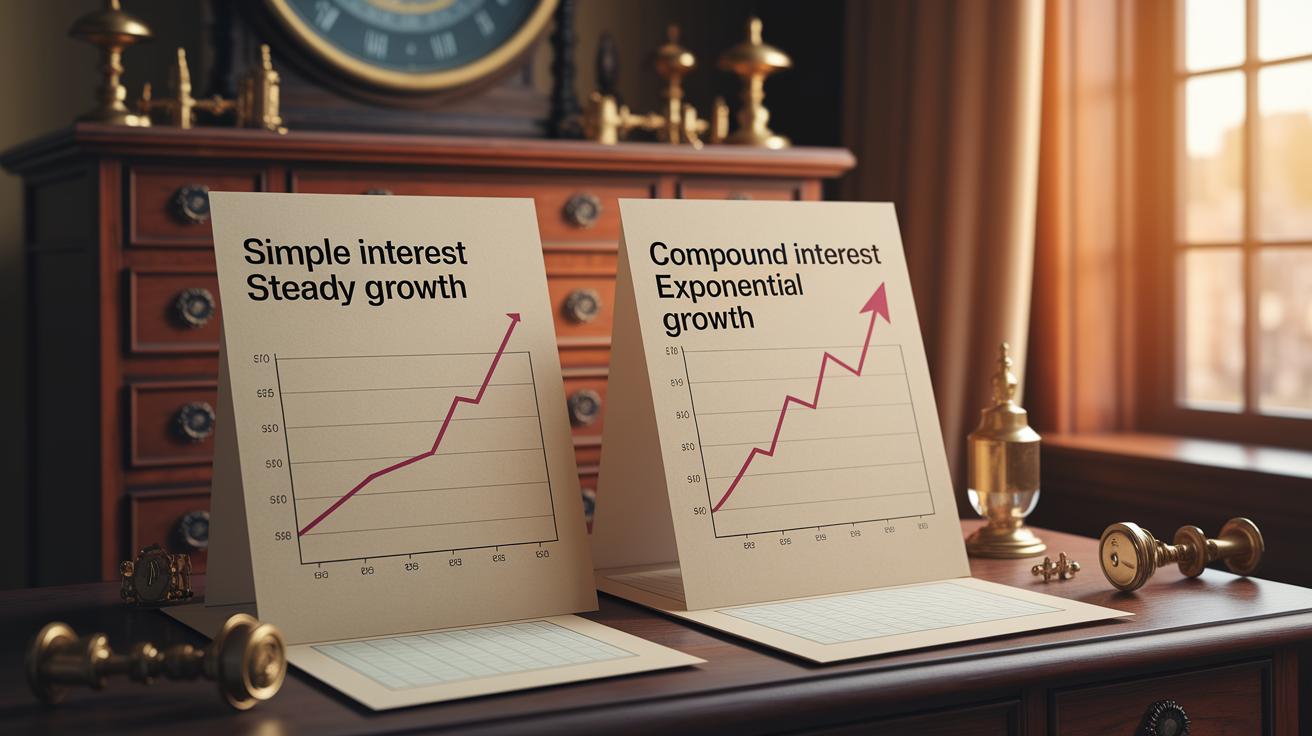
Simple interest is best when you want a steady, clear plan. You see it in auto loans, certain bank CDs, and short-term savings accounts. It only calculates interest on the original amount, so you know exactly what extra amount you'll owe over time. Imagine getting a fixed-rate auto loan where your interest builds at a steady pace, it makes your repayment plan easy to follow. This approach works well when everyone values a simple, predictable path.
Compound interest, on the other hand, is more about growing your money over time. It's common in long-term investments like savings accounts with APY, credit cards, and retirement plans. Here, any money you earn gets added to your original amount, which means you start earning interest on your interest. Think of it like planting a seed that grows into a flourishing tree, then sprouts even more seeds each season. While this can really help your savings grow, it can also work against you by increasing debt if balances go unpaid. Knowing how these methods work can help you choose the right one for your financial goals.
Tools for Calculating Simple vs Compound Interest

Online financial tools make it easy to see how your money can grow. You simply enter your starting amount, rate, time span, and how often your interest adds up. It’s almost like watching a little simulation of cash sprouting leaves in real time.
Spreadsheet formulas are a great hands-on way to explore your options. Using functions like FV (that stands for future value) helps you see what your savings might be worth later on. Tools like IPMT and PMT break down the interest you earn or pay, so you can play around with different numbers and immediately spot new growth patterns in your table.
Finance apps bring it all together with both simple and compound interest features. They let you plan different scenarios easily, so you can compare the steady pace of simple interest with the faster boost of compound interest. Many of these apps even include APY calculators that show you how a nominal rate can turn into a richer effective yield. It’s like having a mini financial lab right in your pocket, making your money journey clear and relatable.
Final Words
In the action, we've compared simple interest (straight-line growth based solely on the original amount) with compound interest (growth that builds on previous interest). We explored clear formulas, practical scenarios, and even handy tools for calculating each type. The article showed how these methods work in different financial settings, making it easier for you to see which fits your needs best. Simple interest vs compound interest remains a key topic in understanding your money, paving the way for confident, informed decisions ahead.
FAQ
What do simple and compound interest calculators do?
The calculators compare the linear growth from simple interest and the exponential growth from compound interest by using your principal, rate, and time to show you potential outcomes.
What are the formulas for simple and compound interest?
The simple interest formula is I = P × R × T, while the compound interest formula is A = P × (1 + R/N)^(N×T). Each variable represents the principal, rate, time, and compounding frequency.
What is an example comparing simple and compound interest?
The example shows that simple interest grows steadily on the original principal while compound interest reinvests earned interest, leading to faster and larger growth over time.
How do simple interest and compound interest loans differ?
In simple interest loans, you pay interest only on the principal, giving predictable costs. In compound interest loans, interest is added periodically, which can increase the total amount owed over time.
Which is better, simple interest or compound interest?
The choice depends on your needs; simple interest offers steady, predictable growth or repayment, while compound interest accelerates growth, benefiting long-term investments but potentially increasing loan costs.
How much is $10,000 at 10% interest for 10 years?
With simple interest, $10,000 grows to $20,000, while compound interest can increase the amount to roughly $25,937, showing a clear boost from calculating interest on prior earnings.
How much is $1,000 worth after 2 years if 6% interest is compounded daily?
Compounding daily at a 6% annual rate, $1,000 grows to about $1,126 after 2 years, demonstrating how more frequent compounding accelerates growth.
What is the compound interest on $8,000 at 5% per annum for 2 years?
Using compound interest, $8,000 accrues nearly $800 in interest over 2 years, bringing the total close to $8,800 when interest is calculated on previously earned amounts.
What does a simple vs compound interest chart show?
The chart visually compares how simple interest grows evenly over time, whereas compound interest accelerates, emphasizing how rate changes and compounding frequency impact overall growth.